
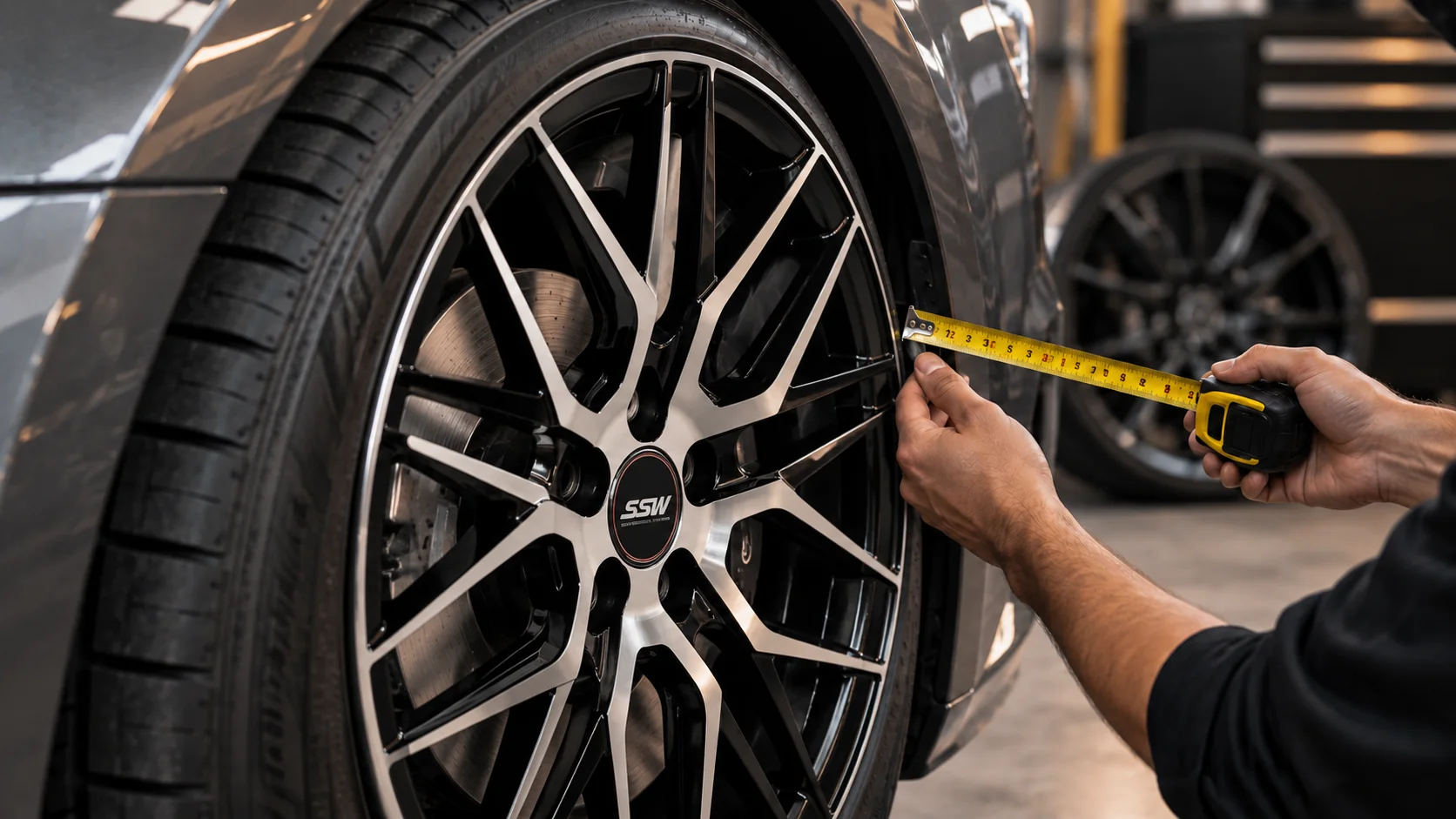
Choosing a wheel because it looks good is easy. Making sure it actually fits your car correctly takes a little more attention.
Before buying an SSW wheel, it is important to understand car wheel fitment because even a small mismatch in diameter, width, PCD, offset or centre bore can affect clearance, steering feel and how the tyre sits on the vehicle. A wheel may have the right number of bolt holes and still not be the right fit.
The good news is that you do not need to become a wheel engineer before upgrading. A few specification checks can help you narrow down the right options before installation.
Understand the Basics of Wheel Fitment
Wheel specifications describe how a rim connects to the vehicle and where it sits in relation to the suspension, brakes and bodywork.
The main measurements to check are:
- Wheel diameter
- Wheel width
- PCD or bolt pattern
- Offset
- Centre bore
- Load rating
- Compatible tyre size
These measurements need to work together. Matching only the wheel diameter is not enough.
Construction is a separate consideration. Cast, flow-formed and forged wheels can all have different characteristics, but they still need the correct dimensions for your vehicle. If you are comparing construction methods, Car Decor’s guide to what flow-formed wheels are and how they differ explains the manufacturing side in more detail.
Check the Wheel Size and Width
Start with the specifications of the wheels already fitted to your car. You can usually find these in the vehicle documentation, on the existing wheel or through the manufacturer’s specifications.
Wheel size is commonly written in a format such as:
17 x 7.5J
Here, 17 refers to the wheel diameter in inches, while 7.5 refers to the width.
When choosing an SSW wheel, going larger or wider should be done carefully. A wider rim can alter how the tyre sits and may move the inner or outer edge closer to suspension components or the wheel arch. A larger diameter also usually requires a tyre with a lower sidewall if you want to keep the overall rolling diameter close to the original setup.
If you are still deciding whether moving away from the factory setup makes sense, this comparison of SSW alloy wheels and OEM alloy wheels can help you understand the broader considerations involved in an aftermarket upgrade.
Check PCD, Offset and Centre Bore
These three specifications are some of the most important fitment checks.
PCD
PCD stands for Pitch Circle Diameter and describes the wheel’s bolt pattern.
A specification such as 5×114.3 means the wheel uses five mounting holes positioned on a circle measuring 114.3 mm in diameter.
The PCD of the wheel needs to match the vehicle hub. A wheel should not be selected simply because it has the same number of bolt holes.
Offset
Offset determines how far inward or outward the wheel sits in relation to the hub mounting surface.
An unsuitable offset can cause the wheel or tyre to sit too far inside or outside the arch. Depending on the setup, this may reduce clearance around suspension components, brakes or bodywork and can influence steering behaviour.
Avoid choosing an aggressive offset purely for a wider-looking stance without first checking clearance.
Centre Bore
The centre bore is the opening in the middle of the wheel that fits over the vehicle hub.
Ideally, the wheel should have a centre bore suited to the vehicle. Some aftermarket wheels can use the correct hub-centric rings where appropriate to achieve the required fit.
PCD, offset and centre bore should therefore be checked as a set rather than individually.
Check Tyre Compatibility Before Upsizing
The wheel and tyre should always be considered as one package.
Correct tyre compatibility depends on the wheel diameter and width as well as the overall rolling diameter required for the car. A tyre that is too narrow or too wide for the rim may not sit as intended, while an excessively low-profile tyre can reduce the amount of sidewall available to absorb sharp road impacts.
When upsizing wheels, the tyre profile is usually reduced so the overall wheel-and-tyre diameter remains reasonably close to the manufacturer’s specification.
This matters particularly on Indian roads. Potholes, broken surfaces and sharp road joints can place more stress on low-profile tyres and larger rims.
Wheel weight, tyre profile and tyre pressure can also influence how the car responds over uneven surfaces. Car Decor’s guide to how SSW wheels can influence handling and comfort explores how these factors work together.
A Quick Wheel Fitment Guide
Use this simple wheel fitment guide before placing an order:
| Check | What to Confirm | Why It Matters |
| Diameter | Matches an approved or suitable size for the car | Affects tyre choice and clearance |
| Width | Works with the selected tyre and available space | Prevents inner or outer clearance issues |
| PCD | Matches the vehicle bolt pattern | Required for correct mounting |
| Offset | Suitable for the vehicle and wheel width | Determines where the wheel sits |
| Centre bore | Correct for the hub or suitable for the appropriate hub-centric solution | Helps ensure proper centring |
| Load rating | Suitable for the vehicle | Ensures the wheel is designed for the required load |
| Tyre size | Appropriate for wheel width and overall diameter | Affects clearance, ride and speedometer accuracy |
If you are changing more than one specification at once, it is worth checking the complete setup rather than judging each number independently.
Common Wheel Fitment Mistakes to Avoid
A lot of aftermarket wheel problems begin before the wheel is installed.
One common wheel fitment mistake is choosing purely by diameter. Two 18-inch wheels, for example, can have completely different widths, offsets, PCDs and centre bores.
Other mistakes include:
- Assuming the same number of bolt holes means the PCD matches
- Choosing an aggressive offset only for appearance
- Upsizing without calculating the new tyre size
- Ignoring brake or suspension clearance
- Selecting a tyre that is unsuitable for the rim width
- Forgetting to confirm the wheel’s load rating
- Using incorrect mounting hardware
- Skipping balancing after installation
Another common mistake is choosing a design first and trying to make the specifications work afterwards. It is safer to shortlist compatible specifications first and then choose the design and finish you prefer.
Pre-Buy Checklist for an SSW Wheel
Before confirming an SSW wheel, keep this checklist handy:
- Confirm your car’s original wheel specifications.
- Check the required diameter and acceptable width.
- Match the PCD exactly.
- Confirm the appropriate offset range.
- Check the centre bore and hub requirements.
- Verify the wheel’s load rating.
- Match the rim with an appropriate tyre size.
- Check inner suspension and outer wheel-arch clearance.
- Consider how much tyre sidewall you need for the roads you regularly drive.
- Confirm that the wheel is genuine and suitable for your vehicle.
- Have the final wheel-and-tyre setup professionally mounted and balanced.
Once the technical fit is sorted, you can focus on the part that is much more fun: choosing the design. Car Decor’s guide to the best SSW alloy wheel designs for Indian cars can help you compare different spoke patterns and styles after narrowing down the specifications that suit your vehicle.
The right wheel upgrade is not simply the largest rim that can be fitted under the arch. Size, tyre choice, offset, clearance and how the car will actually be driven all need to work together. Get those details right before buying, and the final upgrade is far more likely to look right, fit correctly and suit your everyday drive.
For expert wheel fitment guidance, installation support, and competitive prices on SSW wheels, visit Car Decor and find the right setup for your car.