
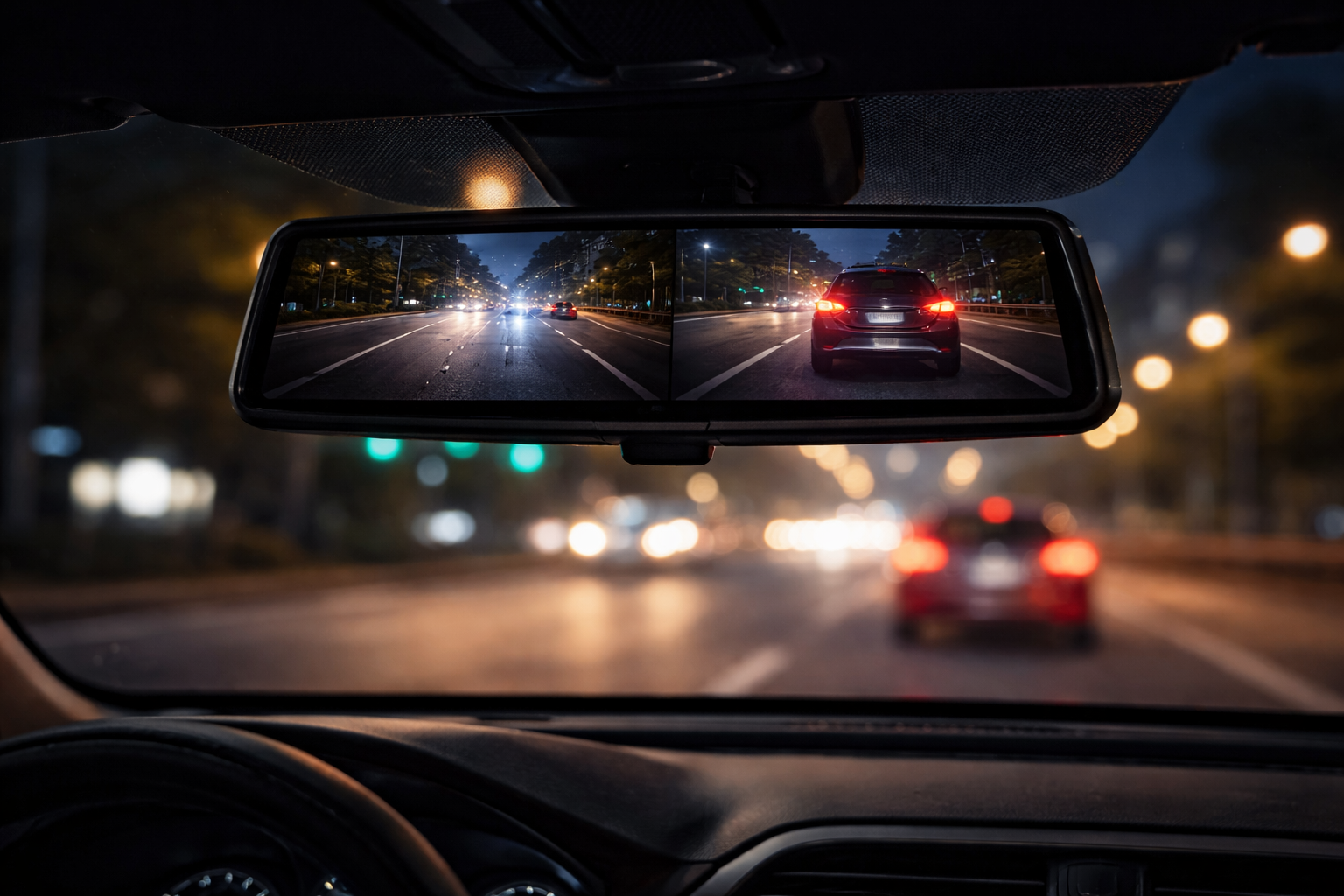
Imagine this scenario. You are driving down Hosur Road in heavy traffic. You stop patiently at a red signal, keeping a safe distance from the car in front. Suddenly, thud. You feel that unmistakable jolt from behind. You have been rear-ended. You step out, and the other driver immediately starts arguing, claiming you reversed into them. Without witnesses, it is your word against theirs. This is a nightmare scenario that plays out on Bengaluru roads every single day.
For years, Indian drivers have started adopting dash cams to protect themselves from these situations. But most people start with a single-channel unit that only faces forward. While that is a great start, it only tells half the story. To truly protect your vehicle in our chaotic traffic, you need eyes in the back of your head, or in this case, a dual channel dash cam.
A dual-channel system records both the view through your windshield and the view through your rear window simultaneously. It provides a complete picture of what is happening around your car. In this guide, we will explore why upgrading to a dual dash camera for car in India is one of the smartest investments you can make for your vehicle’s security and your own peace of mind.
What is a Dual Channel Dash Cam?
Let’s keep it simple. A standard dash cam is a single unit mounted on your front windshield. A dual channel dash cam consists of two cameras connected to a single system. The main unit sits on your front windshield, just like a regular dash cam. The second, smaller camera is mounted on your rear windshield.
Both cameras record video files to the same memory card. When you review the footage, you can see exactly what happened in front of you and behind you at the exact same moment. This synchronization is key. It proves that while you were braking for a dog crossing the road (captured on the front cam), the driver behind you was speeding and failed to stop in time (captured on the rear cam).
Many new drivers ask us about car security cameras and often confuse these with reversing cameras. A reversing camera only turns on when you put the car in reverse gear to help you park. A rear dash cam records continuously while you drive, acting as a silent witness to everything that happens behind your bumper.
Why Rear Recording is Critical in India
If you have driven in India for more than a week, you know that the danger often comes from behind. Tailgating is practically a sport here. Auto-rickshaws squeeze into non-existent gaps, and bikers often ride in your blind spots.
The “He Said, She Said” Problem:
In rear-end collisions, the driver behind is usually at fault. But proving it can be tricky if the other driver lies. They might claim you brake-checked them or rolled back on a slope. A dual dash camera for car in India eliminates this ambiguity. The footage clearly shows their speed, their distance, and their actions leading up to the impact.
Parking Incidents:
We all know the struggle of finding parking in crowded areas like Jayanagar or Koramangala. You park your car perfectly, go for dinner, and come back to find a dent in your bumper or a smashed taillight. With a single front camera, you would never know who did it. A dual-channel system with parking mode can catch the culprit in the act, capturing the license plate of the vehicle that hit you from behind.
Evidence and Insurance Claims
Dealing with insurance companies can be a headache. They need proof before they pay out. When you file a claim for an accident, having video evidence speeds up the process significantly.
When you look for the best car dash camera front and rear india has to offer, you are essentially buying an insurance policy for your insurance policy. If you are involved in a multi-car pileup, having footage from both angles helps investigators piece together the sequence of events. It can prove that you were pushed into the car in front of you by a third vehicle hitting you from behind, potentially saving your No Claim Bonus (NCB).
Furthermore, we have seen cases of road rage where aggressors approach the vehicle from the rear. Having a camera recording that angle provides crucial evidence to the police if the situation escalates.
Key Features to Look For
Not all cameras are created equal. When shopping for a dual-channel setup, there are a few technical specs you should not ignore.
Resolution and Clarity:
Dash cam video quality is the most important factor. There is no point in having a camera if the video is too blurry to read a number plate. Look for a system that records at least 1080p Full HD for both the front and rear channels. Some budget models offer 4K for the front but drop to low-quality 720p or even 480p for the rear. Avoid these. You need clear details from both angles.
Night Vision:
Accidents often happen at night. Sensors like the Sony STARVIS are excellent for low-light conditions. They can brighten up dark footage, allowing you to see details even on unlit highways.
Parking Mode:
This feature keeps the camera running in a low-power state even when the car is off. If the camera detects a shock (like someone bumping your car) or motion, it wakes up and locks the footage.
To keep your camera lens clear and ensure the best video quality, make sure to keep a Microfiber Cloth handy in your glove box. A quick wipe of the lens before you start driving ensures your footage is always crisp.
Installation: Is it Complicated?
Installing a front-only cam is easy, you just stick it on and plug it in. A dual-channel system requires a bit more work because you have to run a cable from the front unit all the way to the rear windshield.
Cable Management:
You don’t want wires dangling all over your cabin. The cable needs to be tucked neatly under the roof liner and the pillar trims. In hatchbacks and SUVs, you also need to route the cable through the rubber grommet in the tailgate so the wire doesn’t get pinched when you open the boot.
While you can do this yourself, it can be tricky if you are not comfortable pulling apart your car’s trim. At Car Decor, we specialize in clean installations. We ensure the wires are hidden completely, leaving your interior looking factory-fresh. While you are upgrading your interior tech, you might also want to check out our Interior Accessories to keep your cabin organized and comfortable.
Comparison: Single vs. Dual Channel
Is the extra cost worth it? Let’s compare.
| Feature | Single Channel | Dual Channel |
| Coverage | Front View Only (approx. 140°) | Front & Rear View (approx. 280° total) |
| Installation | Simple (DIY friendly) | Moderate (Requires cable routing) |
| Cost | Lower | Higher |
| Accident Protection | Head-on collisions only | Head-on & Rear-end collisions |
| Parking Protection | Limited | Comprehensive |
| Storage Usage | Low | High (Two files per minute) |
Managing Storage and Power
Since a dual-channel cam records two video streams at once, it fills up your memory card twice as fast. If you are buying a dual channel dash cam, do not skimp on the SD card. Get a high-endurance card with at least 64GB or 128GB of storage. “High endurance” cards are built to withstand the constant writing and rewriting of data that dash cams perform.
Also, consider how the camera is powered. If you want to use Parking Mode, you cannot just plug it into the cigarette lighter socket, as that turns off when the car is off. You will need a hardwire kit connected to your car’s fuse box. This draws power from the car battery but cuts off before the battery drains completely, ensuring your car still starts in the morning.
For those who love keeping their car gadgets organized, explore our Car Electronics section to find cable clips and other organizers that help keep your dashboard clutter-free.
Conclusion
Driving in India is unpredictable. You can be the safest driver in the world, but you cannot control the person behind you. A single dash cam is good, but a dual channel dash cam provides the complete circle of protection you need on our chaotic roads.
Whether it is proving your innocence in a rear-end collision, catching a parking lot hit-and-run, or just capturing a funny moment on a road trip, the benefits of having front and rear video far outweigh the extra cost. It is about driving with confidence, knowing that if something goes wrong, you have the proof you need.
Don’t wait for an accident to happen before you decide to upgrade. Protect your vehicle from all angles today.
Need help choosing the right camera for your car? Visit Car Decor and let our experts guide you to the perfect security solution.