
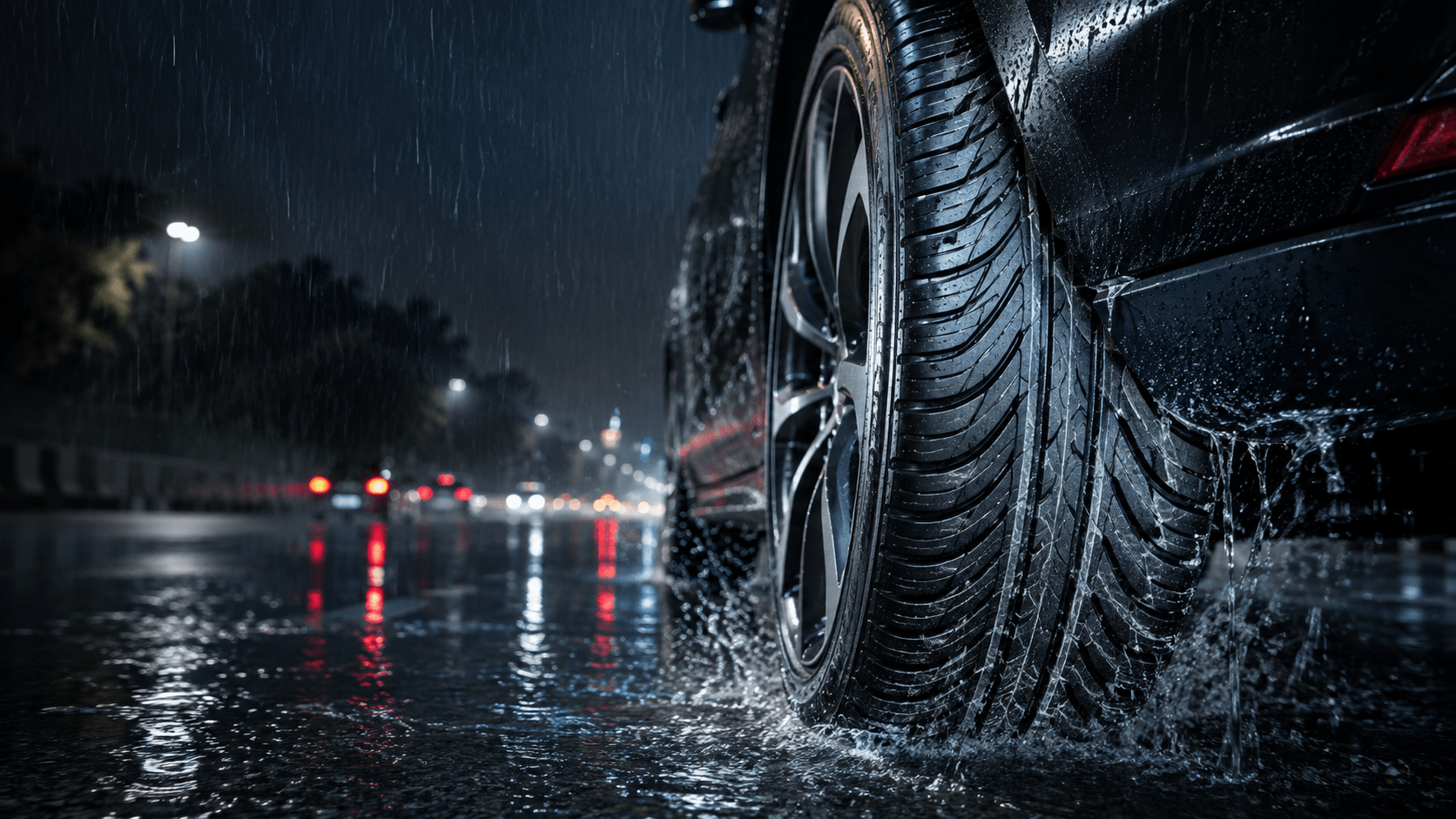
Turn a tyre towards you and read it from the centre to the shoulder. The broad channels carry water, smaller lateral grooves move it across the tread, sipes create extra biting edges, and the outer blocks support the car while it corners. That visible layout is the tyre tread design.
It is tempting to select the pattern with the largest grooves. Wet-road performance is more complicated. Rubber compound, remaining depth, pressure, vehicle weight and speed determine how well the car tyre tread can maintain contact when water covers the road.
Instead of ranking patterns as universally good or bad, use this guide to understand the job each one performs and the trade-off it brings.
First, Understand What Happens Under the Tyre
As a tyre rolls into water, its grooves create escape routes. If the water leaves the contact area quickly enough, the tread blocks continue to meet the surface. If water builds faster than it can be dispersed, the available contact patch reduces and the vehicle may begin to aquaplane.
Higher speed gives the tyre less time to clear water. Deeper standing water, incorrect pressure and worn tread increase the difficulty. This is why a new tyre and the same model near the end of its usable life can behave differently during the monsoon.
A tread pattern therefore balances several jobs at once: water evacuation, braking, steering response, noise, comfort and wear. Two products with four broad grooves can still deliver different wet grip.
Read a Directional Pattern
What you see: V-shaped or arrow-like channels pointing in one rotation direction.
What it is designed to do: Move water outward as the tyre rolls forward. This layout is commonly associated with strong water evacuation and resistance to aquaplaning.
Where it fits: Drivers who regularly encounter heavy rain, standing water or open highways may find directional tyre tread patterns relevant.
What to watch: The arrow on the sidewall must face the direction of travel. Installing the tyre backwards prevents the channels from working as intended. Rotation choices are also more restricted.
Decision: Consider a directional model when wet highway use is a central priority and you accept the fitment and rotation requirements. Still compare the exact compound, construction and tested performance.
Read an Asymmetric Pattern
What you see: Different designs on the inner and outer portions of the tread.
What it is designed to do: The inner section usually uses more open channels for water movement, while larger outer shoulder blocks support cornering and dry-road stability.
Where it fits: Mixed city and highway driving. A well-rated asymmetric touring tyre can balance rain performance, comfort, noise control and everyday steering response.
What to watch: The sidewall is marked inside and outside. The fitter must keep the outside marking facing outward. An asymmetric product that is not also directional usually allows more rotation flexibility.
Decision: This is often the most versatile starting point for Bengaluru drivers who face wet commutes, dry highways and changing surfaces rather than one specialised condition.
Read a Symmetric Pattern
What you see: The same tread arrangement across the entire face.
What it is designed to do: Support predictable wear, quieter operation and flexible tyre rotation.
Where it fits: Everyday hatchbacks and conservatively driven cars where comfort, value and easy maintenance matter.
What to watch: Symmetric tread is generally less specialised for water evacuation than a directional design and lacks the separate wet and cornering zones of an asymmetric design. A high-quality symmetric model can still perform safely in rain.
Decision: Consider it when rotation flexibility and everyday refinement matter, provided credible information for the exact model shows suitable wet performance.
Three Real Tyres, Three Different Approaches
Yokohama BluEarth RV-02: Yokohama describes this compact-SUV and MPV tyre as using an asymmetric pattern, with wet grip, stability, quieter running and resistance to uneven wear among its priorities. The India-focused Earth-1 Max also lists wet grip, comfort and durability. Check the approved size, load index and speed rating. The Yokohama model guide can help narrow the range.
Maxxis Premitra HP5: This model uses a three-rib pattern with four circumferential grooves. Maxxis states that the layout supports water dispersal and hydroplaning resistance, while its silica compound contributes to wet performance. Curved shoulder grooves are intended to reduce tread-area vibration noise. The Maxxis review adds context on comfort, value and model suitability.
Continental UltraContact UC6: Its Aqua Channel surface sipes are designed to direct the water film away as the tread meets the road. Aqua Drainage elements then move water into the main grooves. Continental also describes Diamond Edge as a tread-block feature that helps clear water from the contact surface during braking. The Continental tyre overview explains the brand’s broader premium positioning.
These examples show why simply counting grooves is insufficient. A complete pattern combines large channels, smaller features, compound behaviour and block stiffness.
Do Not Shop for a Generic ‘Monsoon Tyre’
The phrase monsoon tyres is useful in everyday conversation, but it is not a universal technical class for Indian passenger cars. Most owners use summer or all-season road tyres selected to handle both dry and wet conditions.
When comparing wet grip tyres, assess the exact model and size. A compact sedan and a heavy SUV place different loads on the contact patch. Manufacturer information and credible testing should relate to the actual product, not only the brand or tread appearance.
Run the Condition Check Before Replacing by Pattern
The most advanced pattern cannot compensate for poor condition. Inspect all four tyres, not only the easiest outer shoulder to see.
• Measure tread depth at the inner, centre and outer portions.
• Look for uneven wear that may indicate pressure, alignment or suspension issues.
• Replace at the tread-wear indicators, or earlier if cracks, bulges, cuts or other damage appear.
• Check pressure when cold and use the vehicle manufacturer’s recommendation for the load.
• Do not treat the maximum figure moulded on the sidewall as the normal daily target.
• Verify the manufacturing date, warranty route and replacement support.
Remaining tread and correct pressure can matter more in rain than the pattern category printed in a brochure.
Choose by Driving Pattern
Heavy rain and regular wet highways: Start with suitable directional options and accept the rotation restrictions.
Mixed Bengaluru commuting and highways: Compare asymmetric touring products for a balance of water movement, cornering, comfort and noise.
Moderate city use with value and easy rotation as priorities: A suitable symmetric touring tyre may be enough.
Whichever pattern you choose, maintain a larger following distance in rain, avoid sudden steering or braking and do not use cruise control through standing water. No tread design removes the need to reduce speed.
The Best Pattern Is the One That Remains Effective
The best tyre tread patterns for Indian wet roads clear water while retaining stable contact, suit the vehicle specification and remain effective through adequate depth and pressure. Pattern begins the job. Condition, fitment and driving speed decide how much of that capability remains available.
At Car Decor, tyre selection begins with the required size, load index and speed rating, followed by the owner’s route, comfort priorities and rain exposure. The final fitment includes checking the correct orientation and suitability of the selected model.
Planning a tyre change before the monsoon? Bring your regular driving conditions to Car Decor for a pattern-led comparison.